Views: 0 Author: Site Editor Publish Time: 2026-08-14 Origin: Site


Table of Content
Why Ready Meal Manufacturers Choose MAP Packaging
Which Ready Meals Can Be Packaged Using MAP Tray Sealers?
How the MAP Tray Sealing Process Works
Choosing the Right MAP Tray Sealer for Your Production Volume
Key Features to Look for in a Ready Meal MAP Tray Sealer
Common Packaging Challenges for Ready Meals (And How MAP Solves Them)
How to Select the Right MAP Gas Mixture for Different Ready Meals
Ready meals must arrive fresh, safe, and appealing after production, transportation, and storage. A MAP tray sealer helps you achieve all three. By replacing the air inside the package with a protective gas mixture before sealing, you can extend shelf life, preserve product quality, and reduce food waste without using additional preservatives.
This article will discuss how a MAP tray sealer is used to extend the shelf life of ready meals.
MAP tray sealer is a type of packaging equipment that de-aerates the food tray, fills it with a precise mixture of gases, and seals it with a high barrier film. The modified atmosphere preserves food by slowing down the growth of spoilage microorganisms and preventing oxidation, making ready meals more long-lived.
In contrast to a conventional tray sealer, which just seals the food tray with ambient air inside, a MAP tray sealer forms a controlled atmosphere according to your product needs.
The lowering of oxygen and filling of your tray with gases will allow you to prevent the growth of spoilage organisms, limit oxidation, and save your product's taste. This provides you with more room for planning and distributing the products and allows your retailer to display products longer.
Consumers often decide whether to buy a ready meal or not without reading the label. Poor sealing or leakage can deter consumers. With MAP packaging, you can maintain the initial appearance of your product and its protection.
This problem is not only faced by consumers, but it impacts the entire supply chain starting from manufacturers and ending with retailers. The fact that the products remain fresh due to MAP packaging reduces the problem of losses because of expired goods, spoilage during delivery, or damaged packaging.
Cooked Rice Meals: The reason why rice-based meals are popular is that they are convenient, inexpensive, and easy to serve. But sometimes, rice can easily lose its moisture content or even be at risk of developing microbes, especially if it’s not packaged properly. With MAP, it is easier for you to preserve the shape and moisture content of the rice. Examples are fried rice, curry rice, etc.
Pasta and Noodles: When it comes to ready meals that come with sauce, cheese, vegetables, or meat, packaging becomes difficult compared to dry ingredients. Properly sealed MAP packaging can help you keep the sauces from drying out and maintain their overall quality. Examples are lasagna, spaghetti, alfredo pasta, etc.
Meat-Based Ready Meals: Prepared meats are one of the most common products for modified atmosphere packaging. You can use it on any type of meat, whether beef, chicken, pork, or mixed dishes. MAP makes sure that there will be no oxidation and preserves the quality of the product without affecting its taste. Examples are roast chicken meals, barbecue pork, grilled steak with vegetables, etc.
Seafood Meals: Seafood is highly perishable and needs proper packaging throughout the cold chain process. The packaging technique of MAP helps minimize the problem of quality loss of food items while they are kept in a refrigerator because it creates an environment in the tray. Grilled salmon, shrimp pasta, seafood rice bowl, etc., are some of its examples.
Fresh Salads and Vegetable Meals: Consumers increasingly look for healthier meal options made with fresh vegetables. These products require packaging that protects delicate ingredients without crushing them. MAP helps to maintain freshness and preserve texture in meals like grain salads and mixed vegetables.
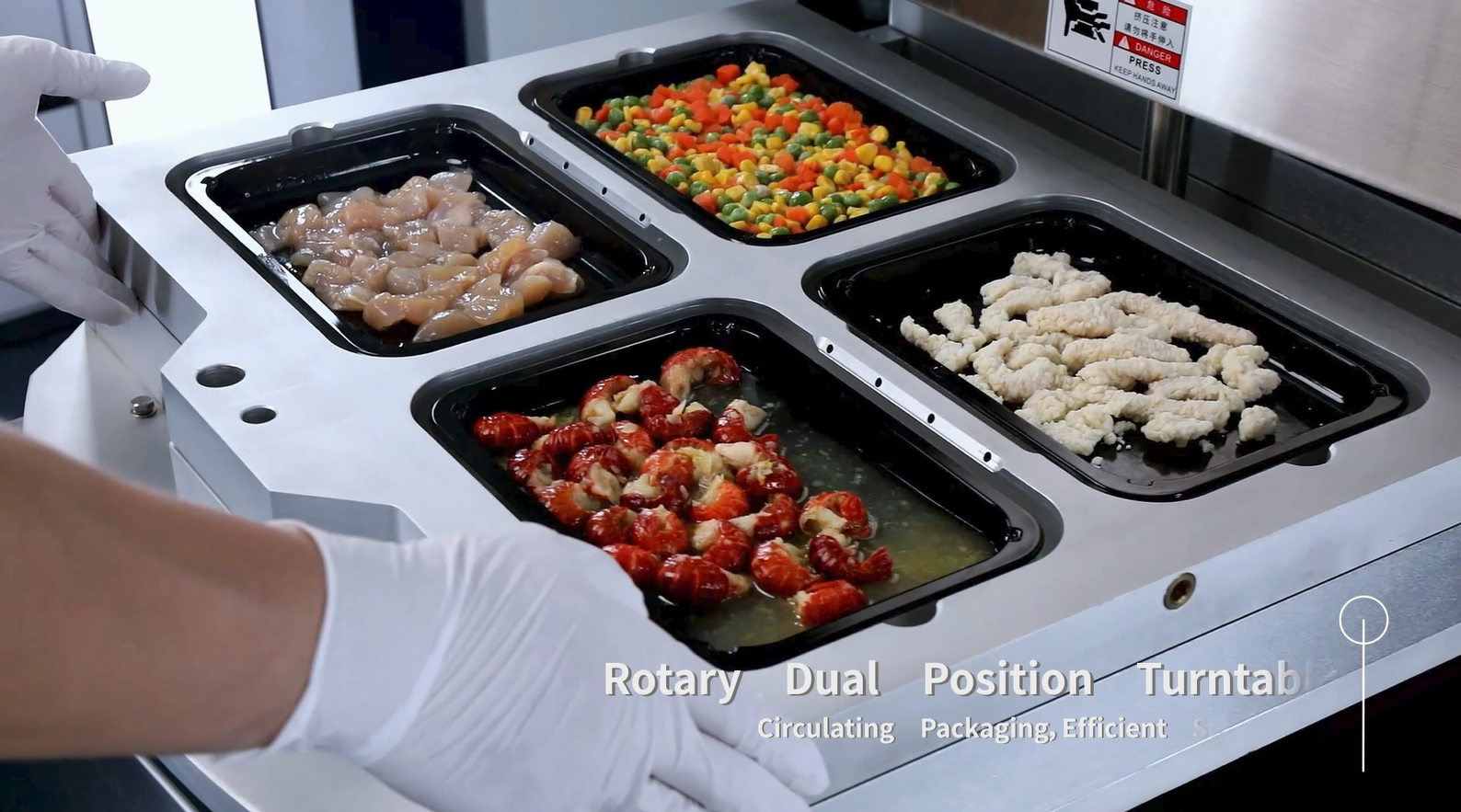
Product filling: Filling involves placement of prepared meals into food trays that have been made from food-grade material. Depending on your production plant, you can choose to fill your food products either manually or using a depositing machine.
Tray positioning: Filling of trays is followed by the positioning of those trays in the packaging equipment using the right mold. The right positioning is important because it makes sure that trays do not move during sealing and also makes sure that seals formed are equal. In case you plan to use different tray sizes, you should choose machinery that is capable of using interchangeable molds.
Vacuum extraction: The machine creates a vacuum to remove most of the air from inside each tray. This helps to reduce mold and bacterial growth.
Gas flushing: After completing the vacuum cycle, the machine will fill the packages with the desired combination of gases. Proper gas control allows for uniform quality of packaging in all batches.
Heat sealing: After gas flushing, the machine heat seals a high barrier film onto the tray. It is important that the seal be reliable since any leaks would lead to contamination of the modified atmosphere by oxygen.
Film cutting: The machine cuts the sealing film to get an attractive and professional package. Good cutting of the film will make the package look good and will reduce waste.
Finished package inspection: Before products move into cold storage or distribution, you should inspect the finished packages for gas retention and package appearance.
If you're producing ready meals in smaller quantities or developing new products, a compact tabletop MAP tray sealer can provide the flexibility you need.
The Hualian HVT-450M Tray Sealing Machine is designed for businesses that want professional packaging without investing in a fully automated production line. Here’s why it is suitable:
Compact Design Saves Valuable Workspace: In some smaller-scale production areas, the floor space is very limited. It is easy to install this tabletop machine without any extra installation space, making it easy for you to include professional packaging into your manufacturing process.
Easy Mold Changes Support Multiple Products: There are some small-scale food manufacturers who package meals of varying sizes depending on the day of the week. HVT-240TS includes a feature of replaceable molds which help switch trays easily.
Professional Packaging Without High Production Volumes: If you are producing fewer quantities but need the same professional-level packaging, you can use HVT-240TS in order to create strong seals for your products.
When production volumes increase, manual packaging quickly becomes a bottleneck. Higher throughput requires equipment that delivers consistent results while minimizing operator intervention.
The Hualian HVT-450A Automatic MAP Tray Sealer is designed for continuous production environments where speed, consistency, and reliability are essential. Here’s why it is suitable:
Automated Packaging Improves Throughput: The HVT-450A integrates different stages of packaging in an automated packaging process. As manual handling is reduced, it will enable packaging of more units of products in shorter periods without compromising quality.
Stable Performance During Continuous Production: Long periods of operation cause heat generation. Without proper management of heat generation, the quality of the seal may be affected. The HVT-450A comes with water cooling that helps in the maintenance of stable sealing temperature during continuous production processes.
Flexible Production for Multiple Tray Sizes: Food processors pack different meal packages to cater to both retail and food service industries. The HVT-450A, with the help of molds, enables changing of different tray sizes.
Many manufacturers package ready meals in multiple tray sizes to serve different retail markets and portion requirements. A machine with interchangeable molds lets you switch between packaging formats without purchasing separate equipment.
Modified atmosphere packaging only works effectively when the intended gas composition is achieved inside the package. A machine with accurate gas replacement helps maintain consistent’s shelf life and reduce oxygen levels.
A package is only as good as its seal. Weak or inconsistent seals can lead to gas leakage, shortening shelf life and increasing the risk of product returns. Look for equipment that delivers uniform sealing pressure and stable sealing temperatures.
Ready meal production requires equipment that can withstand frequent cleaning while meeting hygiene standards. Machines constructed from food-grade stainless steel offer easy cleaning and sanitation, and better corrosion resistance. A hygienic machine design also reduces areas where food residue can accumulate, simplifying routine maintenance.
Packaging settings often need to change when you introduce new tray sizes or meal types. A PLC touchscreen control system allows operators to adjust parameters such as vacuum time and sealing time. Preset recipes can also improve consistency by reducing setup errors between production runs.
Continuous production generates heat that can affect sealing quality if not properly controlled. A water-cooled sealing system helps maintain stable operating temperatures, particularly during long production shifts. The benefits include more consistent seals and reduced risk of overheating.
The ready meal will naturally degrade during storage because of the development of microorganisms and oxidation. The short shelf life will likely lead to an increase in product returns. The use of the controlled atmosphere of gases, MAP, allows slowing down the processes of spoilage and oxidation. The refrigerated shelf life gets extended, which means increased production and shipping flexibility.
Meals with soups, sauces or gravies are prone to leaking if there are irregularities in the sealing. A good MAP tray sealer will provide a proper amount of heat and pressure to form a high-quality and tight seal.
If the product moves around the tray, its attractive appearance may get ruined by the time it gets delivered to the consumer. Good tray design, proper headspace, and sealing will keep your products in the right place.
Condensation may ruin the appearance of the fresh meal, even though the product will remain safe for consumption. Condensation may also affect the visibility of the label. MAP packaging, combined with suitable barrier films and proper cold-chain management, helps maintain a more stable package environment.
Prepared beef, chicken, pork, and lamb are some of the most common products that are packaged using MAP technology. The food items are prone to microbial action and oxidation, which affects shelf life and taste.
A mixture of gases with CO2 is generally used because it delays spoilage organisms' growth. Nitrogen acts as the inert gas for displacement of oxygen from packages and package shaping.
Seafoods have a shorter shelf-life compared to many other packaged prepared foods, thus making good packaging important.
It ensures maintenance of the quality of the seafood through delaying microbial activity and oxidation under refrigeration conditions.
Vegetables keep respiring even after packaging, thus making their packaging needs different from cooked meat products. Failure to choose the right gas mixture will affect product appearance. The packaging technique should be a trade-off between product protection and quality.
Many ready meals contain a combination of meat, vegetables, grains, and sauces. In these cases, the packaging atmosphere should be optimized for the ingredient that presents the greatest preservation challenge.
For example, a chicken-and-rice meal requires different packaging considerations than a vegetable pasta or seafood risotto. Rather than applying the same gas mixture to every product, evaluate each recipe individually to achieve the best balance between shelf life and food quality.
A MAP tray sealer does more than seal food trays; it helps you protect product quality, extend shelf life, and improve packaging efficiency throughout the supply chain. Whether you're producing specialty ready meals or running a high-volume food processing facility, choosing the right equipment can make a measurable difference in product consistency and operational performance.
If you are looking for a MAP tray sealer for ready meal, contact Hualian Machinery to discuss your packaging requirements. We can help you select the right machine for your business.
Modified Atmosphere Packaging (MAP) can extend the shelf life of ready meals from a normal 3 to 5 days up to 10 to 21 days, depending on the food ingredients and storage conditions.
Modified Atmosphere Packaging (MAP) is generally not necessary or ideal for long-term frozen meals, as freezing already stops microbial growth, but it can be used for chilled-to-frozen supply chains. Vacuum sealing or standard barrier packaging is usually preferred for pure freezing.
Tray sealer molds (tooling) do not have a fixed time-based replacement schedule. Instead, they last for years and are only replaced when physical damage, deep deformation, or severe wear occurs.

 English
 简体中文
简体中文 ไทย
ไทย Pусский