Views: 0 Author: Site Editor Publish Time: 2026-03-25 Origin: Site


Table of Content
Why Packaging Materials Matter in Pet Food
Hualian Machinery: Packaging Equipment for Every Material Type
Plastic-Based Packaging Materials
Paper-Based Packaging (Especially Kraft Paper Bags)
Aluminum Foil and Metallized Layers
Multi-Layer Composite Packaging (Industry Standard)
Biodegradable and Compostable Packaging
Flexible Films and Multi-Layer Structures for Retail
Choosing Materials for Wet and Dry Pet Food
Hualian's Pet Food Packaging Solutions
From the moment a bag of kibble is filled on a production line to the moment a pet owner pours it into a bowl, packaging plays a continuous and critical role. It keeps the product safe from contamination, prevents moisture and oxygen from degrading nutritional quality, and communicates the brand promise to consumers on the retail shelf. Get the packaging material wrong, and the highest-quality pet food can arrive stale, damaged, or visually unappealing.
Even to this day, pet food manufacturers continue to search for the best materials to use when packaging their products. So, in this article, we’ve put together a checklist of material combinations that work wonders as far as pet food packaging is concerned.
Pet food packaging serves multiple simultaneous functions that together determine how well a product survives the journey from production to purchase. Understanding why material selection matters helps frame every decision that follows.
Protecting freshness and nutrition: Packaging materials act as barriers against oxygen, moisture, and light; all of which degrade fats, proteins, and vitamins in pet food over time.
Handling heavy product weights: Pet food bags routinely weigh between 1 and 15 kg for retail packs and up to 50 kg for bulk formats. The chosen material must provide the structural integrity to carry that weight through filling, sealing, palletizing, and shipping without tearing or deforming.
Supporting branding and shelf appeal: Premium pet food is a competitive retail category. Packaging materials must accept high-resolution printing and maintain their appearance throughout the supply chain to support brand differentiation at the point of purchase.
Compatibility with automated packaging machines: Modern pet food production relies on automated systems for bag placing, filling, sealing, stitching, and coding. The material must run reliably through these machines without jamming, misfeeding, or inconsistent sealing.
Before exploring the materials themselves, it is worth noting that the machinery used to process them is just as important as the material choice. And for pet food packaging machines, no one does manufacturing quite like Hualian Machinery.
Hualian Machinery manufactures a range of packaging equipment engineered to work with the full spectrum of pet food packaging materials, from heavy-duty woven PP bags to laminated paper-plastic composites and lightweight flexible films. Below are four key machines particularly relevant to pet food production lines.
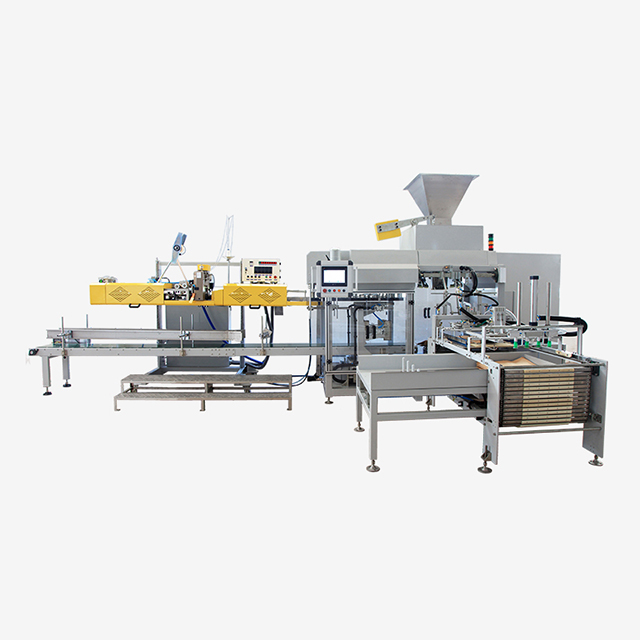
Starting off, we have the Automatic Open Mouth Back Placer System. Unlike most other packaging machines, this system combines two major components:
The ZSG-1000G high-speed open-mouth bag placer
The FBK-332C bag closing and sealing machine
This combination creates a fully automated, end-to-end bagging solution that is designed for packaging granular and powdered materials ranging from 10 to 50 kg per bag. For bulk dry pet food formats, this machine is beyond ideal.
The ZSG-1000G operates at 500 to 800 bags per hour using four servo motors that independently control bag taking, opening, hopper lifting, and bag feeding. The FBK-332C closes bags at up to 8.5 m/min (customizable to 11 m/min) with a temperature range of 0 to 400°C, accepting multi-layer paper bags, paper-PE composite bags, aluminum-PE inner liner bags, and PE bags.
Additional selling points include PLC-controlled automation, fault self-diagnosis, tool-free bag size changeovers, automatic bag-in-place detection to prevent misfills, and full production line integration with conveyors and palletizers.
If you’re packaging using multi-layer kraft paper bags, paper-plastic composite bags, woven PE bags, and paper-woven composite bags, this system is beyond ideal for collaboration.
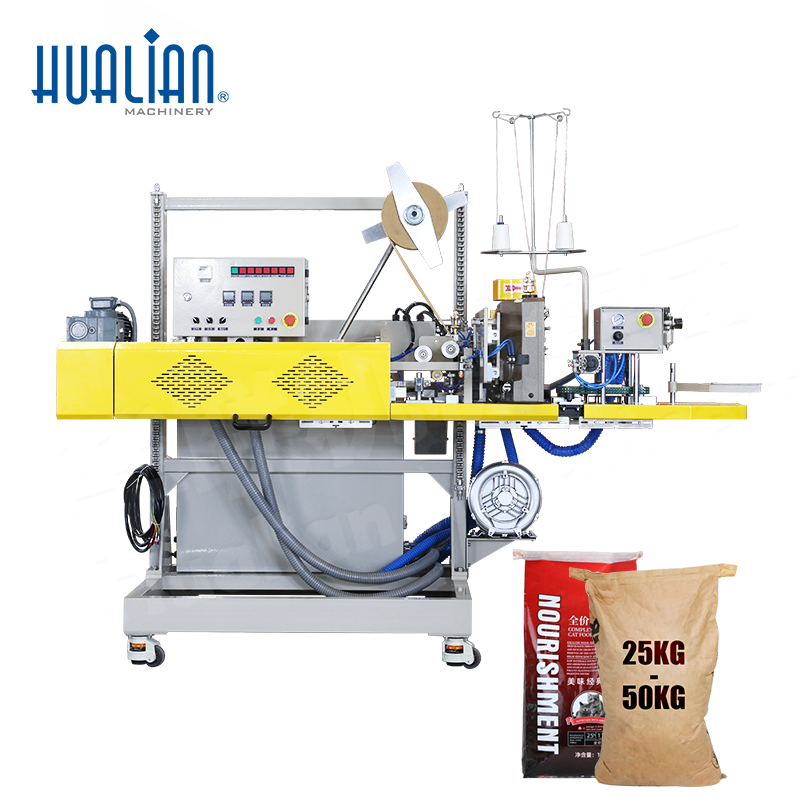
The FBK-13DC Industrial Stitching Bag Packaging Machine is a dedicated industrial bag stitching and sealing machine for 10 to 50 kg paper and composite bags. It automatically performs dust removal (in the DC variant), trimming, stitching, edge binding, cutting, heat sealing, and press closing in a single continuous pass; ideal for kraft paper and paper-plastic composite bags used across dry pet food packaging.
For a snapshot of the machine’s key specifications, check out the following:
Gross power: 5 kW (FBK-13DC)
Sealing speed: 8.5 m/min (customizable to 11 m/min)
Temperature range: 0–400°C
Air source pressure: 0.6 MPa
Sealing center height adjustable from 750 to 1,450 mm
External dimensions: 2,600 × 950 × 1,800 mm, net weight 500 kg.
Material compatibility: Single and multi-layer kraft paper bags, paper-PE compound bags, 2-in-1 and 3-in-1 composite bags, and woven bags.
With this machine, you get nine standard models available, a dust removal mechanism, fault self-diagnosis, compatibility with a conveyor, and excellent sealing performance on laminated and multi-layer bags
The FBH-S Heavy Duty PP Bag Heat Sealing Machine is engineered specifically for large plastic heavy-duty bags, with a focus on PE and PP materials common in industrial and bulk pet food packaging. Its removable sealing module simplifies maintenance, and its elastic pressing mechanism ensures a superior seal even on thick or M-fold bag formats.
Besides being rated for up to 1,800 bags per hour, here are a few key specifications of the machine:
Gross power: 5 kW
Sealing speed: 0–12 m/min
Seal width: 5 mm,
Temperature range: 0–300°C
Max bag width: 460 mm
Maximum total bag thickness: 0.8 mm
Air source pressure: 0.6 MPa
Dimensions: 2,500 × 1,022 × 1,800 mm.
Material compatibility: PE bags (including M-fold), PP bags, and heavy-duty plastic composite bags used in pet food, chemical, and feed packaging.
Other interesting selling points include a high throughput capacity, a removable sealing module for easy cleaning and maintenance, an elastic pressing mechanism for consistent seal quality on thick bag walls, and strong suitability for M-fold PE bag formats.

The FRP-1120LD Continuous Band Sealer combines continuous band sealing with integrated inkjet coding in a single machine, eliminating the need for a separate coding station in mid-volume pet food operations. It runs on a Linux-based touch-screen control system and supports over 20 languages, with rich printing capabilities including text, dates, barcodes, QR codes, and logos.
With this machine, you get a motor power of 200 W, 400W x 2 in sealing power, a sealing of speed 0 to10 m/min, and a seal width of 10 mm. The machine works between 0 and 300°C, and you get a conveyor load capacity of up to 15 kg. Considering that the conveyor dimensions stand at 1,430 × 250 mm and the machine weighs a net of 140 kg, it seems pretty compact overall
Additional selling points for the machine include:
An integrated thermal inkjet coding that removes the need for an additional coding machine
Linux OS for long-term stability
A quad-core 1.5 GHz processor for fast response, support for batch numbers and expiry dates
Sealing counting function added.
The machine is compatible with flexible plastic bags, laminated pouches, PE and PP film bags used across smaller retail pet food formats.
Plastic films are the most widely used material category in pet food packaging, valued for their durability, moisture resistance, flexibility, and compatibility with automated packaging lines. Three plastics dominate the category.
Polyethylene is the most versatile and affordable plastic used in food packaging. It is flexible, moisture-resistant, and fully food-safe, making it a common choice for inner liners in multi-layer bags as well as standalone flexible pouches. In pet food, PE is frequently used as the inner layer of composite bags, where it provides the food-contact surface and the heat-sealable seam. Heavy-duty PE bags in M-fold format are also used for bulk packs up to 50 kg.
Polypropylene is stronger and more rigid than PE, with excellent resistance to chemicals, oils, and punctures. Woven PP bags are a standard format for dry pet food in the 10–50 kg range, with their high tensile strength allowing them to withstand the mechanical stresses of filling, stitching, and palletizing without tearing.
Polyethylene terephthalate (PET) offers high tensile strength and excellent barrier properties in a thin, lightweight film. It is most commonly used as the outer printed layer of multi-layer composite bags because of its exceptional printability and resistance to tearing during handling and shipping. On the retail shelf, a PET outer layer allows vivid, high-resolution graphics to be applied without risk of scuffing or fading through the supply chain.
Paper packaging has been a staple of dry pet food packaging for decades and remains widely used, especially in mid-range and natural/organic product positioning.
Kraft paper's popularity in pet food stems from several practical and commercial advantages. It has excellent structural strength for heavier product weights, providing a rigid bag format that stacks cleanly on retail shelves. Its natural, unbleached appearance appeals strongly to the clean-label and eco-conscious consumer segments that drive premium pet food sales. And because kraft paper accepts high-quality printing, it supports the detailed ingredient labeling and brand storytelling that modern pet food packaging requires.
Paper alone does not provide sufficient moisture protection for most pet food products. Dry kibble absorbs ambient humidity, softening in texture and becoming susceptible to mold growth if exposed to moisture over time. For this reason, virtually all commercial kraft paper pet food bags include either a plastic inner liner or a laminated coating. These additions provide the moisture barrier that paper cannot, while the paper outer layer retains its structural and aesthetic properties. The result is a paper-plastic composite bag that delivers the benefits of both materials.
Paper bags and paper-composite bags are typically closed using industrial stitching systems, which sew the bag mouth shut with thread and then apply a heat-sealed paper tape over the stitching for added durability. The Hualian FBK-13DC is purpose-built for this process, handling single and multi-layer kraft paper bags as well as paper-PE and paper-woven composite formats.
For products where shelf life and freshness preservation are top priorities, aluminum foil or metallized film layers offer the strongest available barrier performance.
Aluminum foil is essentially impermeable to oxygen, moisture, and light; the three primary environmental factors that drive pet food degradation. When incorporated into a laminated multi-layer structure, it dramatically extends shelf life while preserving the aroma and flavor characteristics that make food palatable to animals.
Aluminum foil and metallized film layers appear across several premium pet food applications:
Premium dry kibble packaging where the brand emphasizes freshness and no-preservative formulation
Wet food stand-up pouches and sachets
Long shelf-life treat packaging where the product may sit on shelf for extended periods before purchase.
The dominant packaging format in commercial pet food today is not made from a single material at all, but from several materials bonded together in a laminated structure. Each layer serves a distinct function that the others cannot provide, and together they create a package that is stronger, safer, and better-performing than any single material could be.
A typical multi-layer pet food bag is constructed with the following:
An outer layer (usually PET or kraft paper) that provides structural integrity and printability
A middle barrier layer — typically EVOH (ethylene vinyl alcohol) or aluminum foil — blocks oxygen and moisture from penetrating the package
An inner food-contact layer (typically PE) provides the sealing surface and ensures the material in direct contact with the pet food is food-safe and non-reactive.
More sophisticated structures may add additional layers for puncture resistance, UV protection, or enhanced barrier performance.
As sustainability concerns reshape consumer purchasing decisions, biodegradable and compostable packaging materials are attracting increased attention in the pet food sector.
Polylactic acid (PLA), derived from renewable plant sources such as corn starch, is the most widely trialed bioplastic in food packaging. However, certified compostable films and paper-based compostable laminates are also entering the market.
The appeal of these materials is clear: packaging that breaks down at end of life rather than persisting in the environment for centuries aligns with the values of environmentally conscious pet owners, who represent a growing and influential consumer segment. Some premium and direct-to-consumer pet food brands have adopted compostable mailers and pouches as part of a broader sustainability positioning strategy.
Metal cans (typically tinplate or aluminum) remain the dominant format for wet pet food. They offer unmatched shelf-life performance and product protection for moisture-rich, high-protein products that would spoil rapidly in other formats.
Wet pet food typically contains 70–85% moisture, making it highly susceptible to microbial growth and oxidative spoilage if not properly protected. Tinplate cans are filled and sealed under sterile conditions and then subjected to retort sterilization to kill pathogens and create a commercially sterile product with a shelf life of two years or more at ambient temperature.
At the moment, no other packaging format provides this combination of barrier performance, structural protection, and heat processability.
Driven by consumer convenience preferences and retailer demand for lighter, more compact formats, flexible films now feature prominently across dry treats, wet food single-serve sachets, and small-portion kibble bags.
The same multi-layer lamination principles that apply to heavy bags apply to flexible formats. A typical stand-up pouch for premium dry cat food might combine a PET outer layer for printing, an aluminum or EVOH barrier layer in the middle, and a PE inner layer for sealing. Resealable zippers can be incorporated into stand-up pouches to improve consumer convenience and maintain freshness after opening, which is a significant factor in the category's growth.
The moisture content of a pet food product is the single most important factor in determining appropriate packaging material. Wet and dry products have fundamentally different preservation requirements that demand very different material solutions.
Dry kibble and pellet products typically contain less than 12% moisture. They require packaging that prevents moisture ingress from the environment, blocks oxygen to prevent fat oxidation, and provides sufficient structural strength for bulk formats of up to 50 kg.
For premium dry products, EVOH or aluminum barrier layers are added to extend shelf life and support reduced-preservative formulations. Paper-based bags with PE inner liners remain common for mid-market dry food, particularly for brands where a natural aesthetic is part of the product's appeal.
Wet pet food requires hermetically sealed, sterile packaging capable of withstanding retort sterilization temperatures. Tinplate cans are the most established solution and continue to dominate the shelf.
Flexible retort pouches are the primary alternative, offering lighter weight and easier consumer opening without sacrificing the shelf stability that wet food demands. Single-serve aluminum foil trays, sealed with laminated lidding film, occupy a premium positioning in the wet food segment, particularly for cat food.
Hualian Machinery's product range covers the key packaging operations required across all of the material types discussed above.
The ZSG-1000G + FBK-332C system addresses high-volume open-mouth bagging for composite and paper-plastic bags, delivering output rates of up to 1,000 bags per hour with PLC-controlled automation.
The FBK-13DC provides dedicated industrial stitching and sealing for kraft paper and paper-composite bags in the 10–50 kg range, with integrated dust removal for clean production environments.
The FBH-S brings high-throughput heat sealing to heavy-duty PE and PP plastic bags, at up to 1,800 bags per hour with an easily maintained removable sealing module. And the FRP-1120LD offers combined band sealing and inkjet coding in a single compact footprint, suitable for smaller flexible format bags used in retail pet food.
Together, these machines reflect Hualian's understanding that pet food packaging encompasses a wide range of material types, bag formats, and production scales, and that effective packaging requires both the right material and the right machinery. Visit Hualian's pet food packaging page for the full range of available solutions.
For manufacturers, choosing the right material for pet food packaging is only half the equation. The machinery used to fill, seal, stitch, and code those bags must be equally well-matched to the material, the production volume, and the final package format. Material and machinery decisions should be made together, not in isolation.
Hualian Machinery offers packaging equipment designed to work across this full spectrum of pet food materials and formats. To learn more about which machines best fit your production needs, contact the Hualian team directly.

 English
 简体中文
简体中文 ไทย
ไทย Pусский