Views: 0 Author: Site Editor Publish Time: 2026-03-25 Origin: Site


Table of Content
The Key Components of a Pet Food Packaging Machine
Types of Pet Food Products Packaged
How a Pet Food Packaging Machine Works: Step by Step
Hualian Machinery's Pet Food Packaging Machines
The Benefits of Using Pet Food Packaging Machines
Choosing the Right Pet Food Packaging Machine
Meeting Industry Standards for Packaging Machines
A pet food packaging machine is the equipment that turns pet food into finished, shelf-ready products by handling weighing, filling, sealing, and packing. For manufacturers, it plays a major role in product quality, packaging consistency, and daily output.
With production demands rising, automation is now critical for improving speed, reducing waste, and keeping operations efficient. Hualian has become a trusted name in pet food packaging solutions by combining deep industry expertise with innovative machine design. Whether the goal is better accuracy, higher throughput, or more reliable performance, the right system can make a measurable difference for long-term productivity and packaging quality.
In this article, we will look at how pet food packaging machines work, their functions, types, benefits, and key selection tips.
A pet food packaging machine performs one or more of the automated tasks required to take a finished pet food product and prepare it for shipment and sale.
In practice, this covers a wide spectrum of functions, and the term is often used to describe entire integrated packaging lines rather than single standalone units.
The core packaging tasks these machines perform include:
Bag feeding and placement: Automatically picking empty bags from a magazine or stack, opening the bag mouth, and positioning the bag correctly under the filling spout.
Product filling and weighing: Dispensing the correct quantity of product into each bag, typically using gravimetric (weight-based) or volumetric measurement systems.
Bag sealing or stitching: Closing the filled bag using the appropriate method for the packaging material — heat sealing for plastic bags, stitching for paper bags, or band sealing for smaller flexible formats.
Printing codes and dates: Applying manufacturing dates, expiration dates, batch codes, and other traceability information to the sealed package.
Pet food packaging machines are used across a broad range of product types, including:
Dry kibble and pellets for dogs and cats, typically packaged in bags ranging from 1 kg to 50 kg.
Cat food in small-format pouches, sachets, or retail bags.
Pet treats (biscuits, chews, dental sticks, and freeze-dried formats) often in flexible pouches or retail bags.
Animal feed and bulk pet food destined for veterinary practices, breeding facilities, zoos, or resale distribution in industrial-weight bags.
Wet food pouches, sachets, and retort-ready formats for moisture-rich products.
Each of these product types may require a different combination of filling system, bag format, sealing method, and coding capability, which is why pet food packaging lines are typically assembled from specialized modular machines rather than a single all-purpose unit.
An automated pet food packaging line follows a structured sequence of operations from empty bag to finished, coded, sealed package. Understanding each stage clarifies both the engineering requirements and the points where machine selection has the greatest impact on output quality.
The process begins with the empty bag. On manual lines, operators load bags one by one onto the filling spout. On automated lines, a bag placing machine handles this task entirely. The machine picks individual bags from a pre-loaded stack using vacuum suction cups, opens the bag mouth using an air jet or suction mechanism, and positions the opened bag precisely over the filling spout. Sensors verify that the bag is correctly placed before the filling stage begins, preventing misfills caused by misaligned or unopened bags.
The speed and reliability of this stage set the ceiling for the entire line's throughput. An automatic bag placer operating at 800–1,000 bags per hour means the rest of the line must be capable of keeping pace at that rate. Hualian's ZSG-1000G achieves exactly this, with four independent servo motors governing each stage of the bag-handling process for consistent, high-speed operation.
Once the bag is in position, the filling system dispenses the correct quantity of product. Weight accuracy at this stage is critical for two reasons: it determines whether the labeled net weight is correct (a regulatory requirement), and it controls give-away, which is the extra product dispensed above the nominal weight that represents a direct cost to the manufacturer. Even a few grams of consistent overfill across hundreds of thousands of bags per year amounts to substantial financial loss.
Modern pet food packaging lines typically use gravimetric filling systems; either net-weight fillers that weigh the product before dispensing, or gross-weight systems that weigh the bag plus product throughout filling. For granular products like dry kibble, multi-head combination weighers can achieve very high throughput with tight weight tolerances. The filling stage also includes mechanisms to level the product inside the bag and exhaust trapped air from the top of the filled bag before sealing, ensuring a flat, compact profile that seals cleanly.
Sealing is the most material-dependent stage of the process, and the sealing method used must be matched precisely to the bag material. Three methods dominate pet food applications.
Heat sealing uses controlled heat and pressure to fuse the inner polyethylene layers of plastic bags together, creating a hermetic closure. Heat sealing is the standard method for PE and PP plastic bags, including woven PP and composite bags with PE inner layers.
Industrial stitching sews the bag mouth closed with thread, then applies a heat-sealed paper tape over the stitching for additional protection against dust, moisture, and contamination. This is the standard closure method for kraft paper bags and paper-plastic composite bags.
Continuous band sealing passes bags through heated sealing rollers on a conveyor belt, applying an even seal across the full width of the bag mouth. This method is well-suited to smaller retail-format bags in flexible film or laminated pouch formats.
Seal quality is non-negotiable. A failed or inconsistent seal allows air and moisture to infiltrate the package, compromising freshness, accelerating spoilage, and creating potential food safety issues. Every bag that leaves a sealing station should have a uniform, contamination-free seal that maintains its integrity through palletizing, shipping, and retail handling.
After sealing, each bag must be marked with the information required by food safety regulations and internal traceability systems. This typically includes the manufacturing date, the expiration or best-before date, and a batch code that links the package to a specific production run. Some markets also require additional information such as lot numbers, production facility codes, or QR codes linking to digital product information.
Coding can be integrated into the sealing machine — as in Hualian's FRP-1120LD, which combines band sealing with a built-in thermal inkjet printing system — or added as a separate inline coding station. Integrated coding reduces the machine footprint and eliminates the coordination complexity between separate sealing and coding units, making it an attractive option for operations with limited floor space.
The sealed and coded bags discharge onto a conveyor system that carries them to the next stage of the production process.
Depending on the line configuration, this may involve an inline quality inspection station, where camera systems or weight checkweighers verify seal integrity and correct fill weight, followed by secondary packaging, case packing, palletizing, and stretch-wrapping for shipment. Some lines include automatic rejection systems that divert non-conforming bags before they reach the case packer, maintaining downstream quality without requiring manual inspection of every unit.
Hualian Machinery offers a focused range of machines covering each of the critical stages described above. The following four machines represent the core of Hualian's offering for pet food packaging lines.
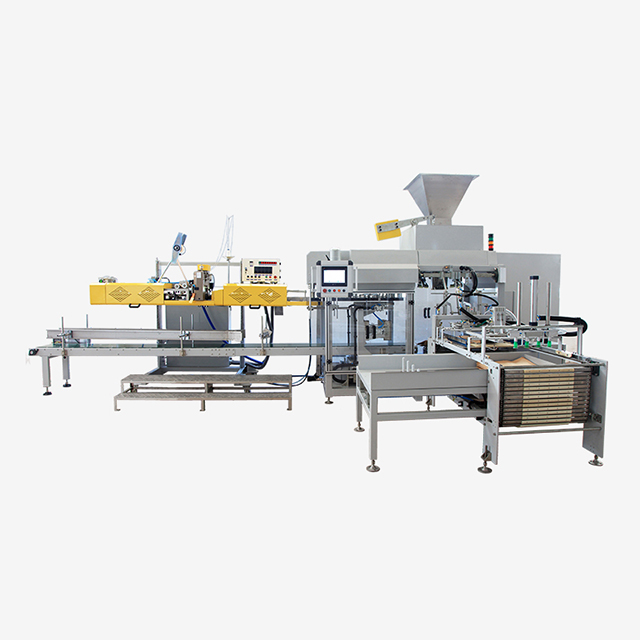
With the Automatic Open Mouth Bag Placer System, we’ve paired the ZSG-1000G high-speed open-mouth bag placer with the FBK-332C bag closing machine, delivering a fully automated bag loading, filling, and sealing solution for heavy bags in the 20–50 kg range. It is particularly well-suited to large-format dry pet food and animal feed packaging in paper, composite, and woven PE bag formats.
The system is compatible with multi-layer kraft paper bags, paper-PE composite bags, paper-woven composite bags, woven PE bags, and aluminum-PE inner liner bags. Suitable for pet food, animal feed, grain, chemical raw materials, and other granular or powdered products.
The ZSG-1000G runs at 800 to 1,000 bags per hour with four servo motors controlling bag taking, opening, hopper lifting, and feeding. It operates on 3-phase AC 380V/50Hz power with a total power draw of 13 kW and an air supply pressure of 0.4–0.6 MPa.
The FBK-332C sealing unit achieves sealing speeds of 8.5 m/min (customizable to 11 m/min) with a temperature range of 0–400°C and gross power of 6.5 kW. External dimensions of the FBK-332C are 3,030 × 950 × 1,800 mm, net weight 600 kg.
With this system, you get full PLC automation from bag placement through sealing, automatic bag-in-place detection to prevent misfills, and tool-free bag size changeovers for flexible production. It also comes with fault self-diagnosis for reduced downtime, and proven production line integration capability with conveyors, palletizers, and stretch wrappers.
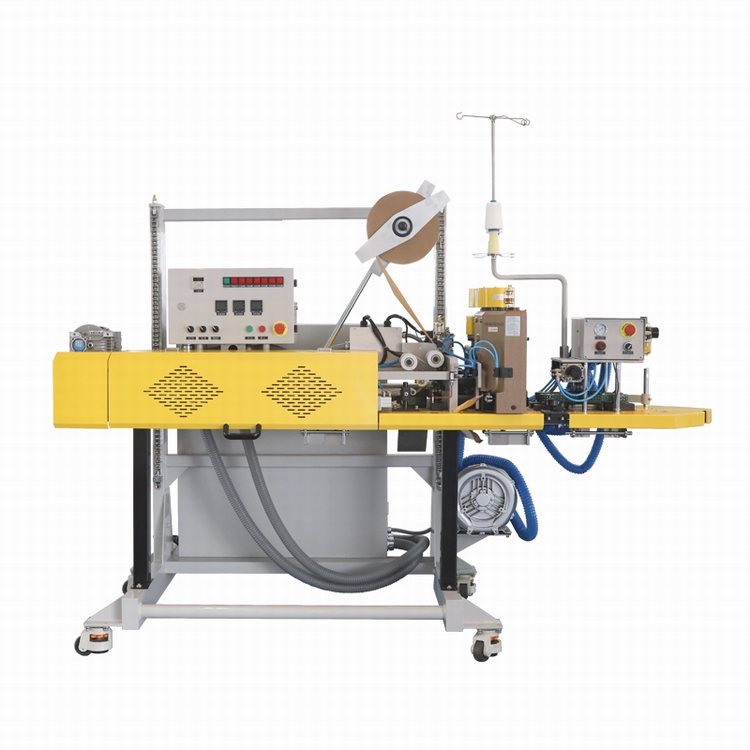
The FBK-13DC Industrial Stitching Bag Packaging Machine is a dedicated industrial bag stitching and sealing machine designed specifically for paper and paper-composite bags in the 10–50 kg range.
It automates the full bag-closing sequence in a single continuous pass, eliminating labor and inconsistency for manufacturers packaging dry pet food in kraft paper or paper-plastic composite bags at production volumes.
This machine is actually available in four variants
FBK-13C
FBK-13DC
FBK-14C
FBK-14DC
For the mall, you get gross power ranging from 4.5 to 6 kW. They all operate on AC 380V/50Hz, with a sealing speed of 8.5 m/min, customizable to 11 m/min. Operating temperatures range from 0 to 400°C, while air source pressure is 0.6 MPa. Sealing center height is adjustable from 750 to 1,450 mm. External dimensions (FBK-13DC): 2,600 × 950 × 1,800 mm, net weight 500 kg. The DC variants include an integrated 0.75 kW deduster.
Nine standard models across the FBK range allow it to match different production volumes and bag specifications. You also get an integrated dust removal mechanism in DC variants for clean production environments, fault self-diagnosis to minimize operator intervention, and sealing performance rated for even the thickest bag materials in the market.
The machine is compatible with single and multi-layer kraft paper bags, paper-PE compound bags, 2-in-1 and 3-in-1 composite bags, woven bags. Suitable for pet food, milk powder, grain, fertilizer, charcoal, and other granular or powdered products in paper-based formats.

The FBH-S Bag Heat Sealing Machine is designed for the specific demands of large plastic PE and PP bag sealing in industrial pet food, feed, and chemical packaging contexts. Its removable sealing module design addresses one of the most common operational pain points in heavy-duty bag sealing, which is maintenance access. At the same time, its elastic pressing mechanism ensures a consistent, tight seal even across thick or uneven bag walls at production speeds.
Model FBH-S, AC 380V/50Hz 3-phase power supply, gross power 5 kW. Sealing speed 0–12 m/min, seal width 5 mm, temperature range 0–300°C. Max bag width 460 mm, maximum total bag wall thickness 0.8 mm. Air source pressure 0.6 MPa. Sealing center height adjustable from 800 to 1,400 mm. Heater move stroke 550 mm. Overall dimensions 2,500 × 1,022 × 1,800 mm. Rated throughput up to 1,800 bags per hour.
Industry-leading throughput of up to 1,800 bags per hour, removable sealing module for straightforward cleaning and maintenance without line downtime, elastic pressing mechanism for superior seal consistency on thick or M-fold PE bags, and adjustable sealing height to accommodate varying bag formats without significant reconfiguration.
The machine is also compatible with PE bags including M-fold formats, polypropylene (PP) woven and film bags, heavy-duty plastic composite bags. Suitable for pet food, chemical products, fertilizer, rice, and other bulk materials requiring robust plastic bag sealing.
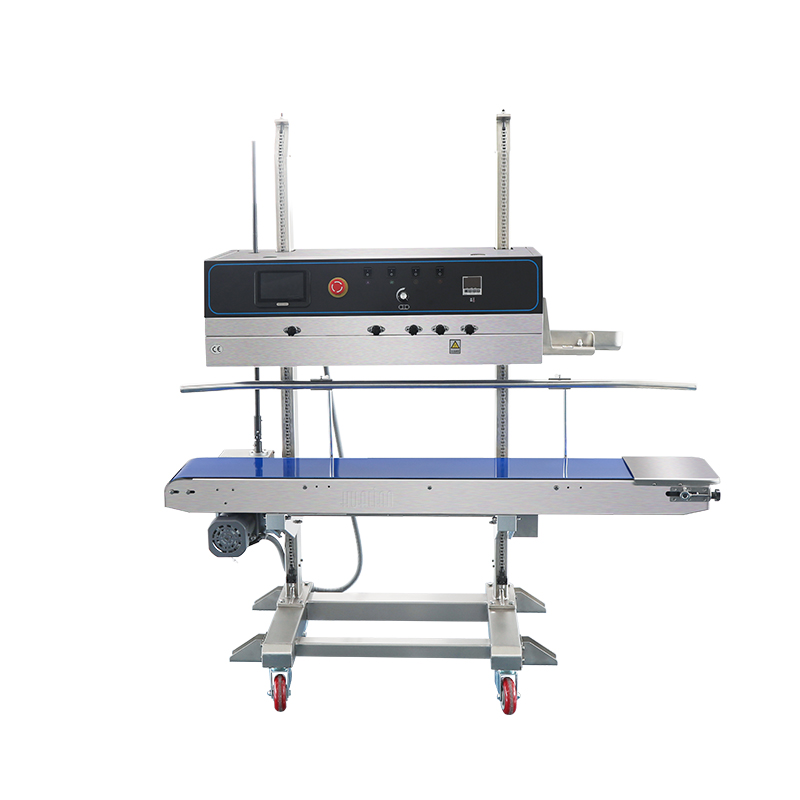
Finally, we have the FRP-1120LD Coding Continuous Band Sealer, which integrates continuous band sealing with a full thermal inkjet coding system in a single machine, eliminating the need for a dedicated coding station in smaller-format pet food packaging operations.
Its Linux-based touch-screen control system, which runs on a quad-core 1.5 GHz processor, provides fast response, long-term operating stability, and rich printing capabilities covering everything from text and dates to barcodes, QR codes, and logos.
AC 220V/50Hz (or 110V/60Hz), motor power 200 W, sealing power 400 W × 2. Sealing speed 0–10 m/min, seal width 10 mm, temperature range 0–300°C. Conveyor size 1,430 × 250 mm, max conveyor load 15 kg, sealing center height adjustable from 100 to 700 mm. Overall dimensions 1,430 × 680 × 1,570 mm, net weight 140 kg.
Integrated thermal inkjet coding removes the cost and complexity of a separate coding machine, Linux OS for long-term stability in continuous production environments, support for over 20 languages with smart input methods, batch counting function, and the ability to print text, dates, symbols, logos, 2D codes, and barcodes in a single pass.
The machine is compatible with flexible plastic bags, laminated pouches, PE and PP film bags, and multi-layer retail packaging formats used for smaller pet food packs, treats, and specialty products.
The business case for investing in automated pet food packaging equipment rests on four interconnected advantages that compound over time.
Automated packaging machines operate at speeds that are simply not achievable with manual labor.
Hualian's ZSG-1000G places and fills 800–1,000 bags per hour, while the FBH-S seals up to 1,800 bags per hour. A team of manual packers working at full capacity cannot approach these rates, and unlike human workers, machines maintain that output consistently across an eight-hour shift, a twelve-hour shift, or a continuous 24-hour production run.
Manual packaging introduces variability at every stage. Weight accuracy depends on the skill and attention of individual operators, seal quality varies with technique and fatigue, and the uniformity of the finished package is difficult to maintain at high volumes.
Automated machines eliminate this variability. Weight is controlled by calibrated measurement systems. Sealing temperature, pressure, and dwell time are set to precise parameters and applied identically to every bag. The result is accurate fills, uniform seals, and a professional finished appearance across every unit of output.
Automated packaging systems reduce direct human contact with the product throughout the packaging process. Fewer touchpoints mean fewer opportunities for contamination from personnel, and the controlled, enclosed nature of automated filling and sealing systems limits exposure to airborne contaminants in the production environment.
Labor is one of the largest variable costs in food manufacturing, and packaging is typically one of the most labor-intensive operations on the production floor. Automation allows manufacturers to significantly reduce the headcount required to run a packaging line while simultaneously increasing output.
With a clear understanding of how these machines work and what they deliver, the practical question for manufacturers becomes: which machine is right for my operation? Five factors should guide that decision.
The machine must be compatible with both your product and your packaging material. A bag sealer optimized for plastic PE bags is not the right tool for kraft paper bags. A bag placer designed for 10–50 kg open-mouth bags will not work with small stand-up pouches.
Match the machine's rated throughput to your actual production requirements; not your peak aspiration, but your realistic day-to-day volume. A machine running at 60% of rated capacity is more reliable and easier to maintain than one running at its rated limit. Factor in planned downtime for cleaning, changeovers, and maintenance when calculating the net production hours available.
Packaging machines require regular maintenance to sustain their performance and extend their operating life. Evaluate how accessible the machine's wear components are (sealing elements, belts, bearings, and sensors) and how frequently they need to be replaced.
The purchase price of a packaging machine is only one component of its total cost of ownership. Factor in installation, commissioning, operator training, consumables (sealing wire, stitching thread, coding ink), planned maintenance costs, and energy consumption over the expected operating life.
The quality of after-sales support is as important as the quality of the machine itself. A packaging line that stops for several days because a replacement part is unavailable, or because no technical support is accessible, costs far more than the repair itself in lost production.
Hualian provides dedicated after-sales service support alongside comprehensive documentation and downloadable technical resources to minimize operational disruption.
Pet food packaging machines must support compliance with the regulatory and quality standards that govern the pet food industry. In this regard, three areas are particularly important.
Pet food is subject to food safety regulation in most markets, even though it is not intended for human consumption.
Equipment used in contact with or close proximity to the product should be constructed from food-compatible materials — typically stainless steel for product-contact surfaces — and should be designed for effective cleaning and sanitization. Automated filling and sealing systems that minimize open product exposure reduce contamination risk and simplify compliance with HACCP-based food safety management systems.
The machine must be capable of reliably sealing the specific packaging materials used for your product, and sealing them to the standard required to maintain freshness and structural integrity through the supply chain.
This means not just achieving a seal, but achieving a seal of consistent quality across every bag, at full production speed, over extended operating periods. Temperature ranges, seal pressure settings, and sealing width must all be appropriate for the material structure being processed. Mismatched equipment and materials are a common source of seal failures in production environments.
Integrated coding capability has now become a regulatory and commercial necessity. Most markets require that packaged pet food carry a best-before or use-by date, a lot or batch code, and the name and address of the responsible party.
Some retail and export customers additionally require QR codes, barcodes, or RFID-compatible labeling. Packaging machines that include integrated coding, such as the FRP-1120LD with its built-in thermal inkjet system, simplify traceability compliance and ensure that coding information is applied consistently and legibly to every package without a separate operational step.
A pet food packaging machine is industrial equipment that automates the process of filling, sealing, and coding pet food packages for commercial distribution. In practice, it is not a single device but a coordinated sequence of automated operations that begins with an empty bag and ends with a correctly filled, hermetically sealed, and traceable finished package ready for palletizing and shipment.
Hualian Machinery's range covers the critical operations in pet food packaging lines, from automated bag placing to stitching and integrated coding. To explore Hualian's full pet food packaging line and discuss the right solution for your production needs, visit hualianmachinery or contact the Hualian team directly.

 English
 简体中文
简体中文 ไทย
ไทย Pусский