Views: 0 Author: Site Editor Publish Time: 2026-11-25 Origin: Site


Are you planning to launch your own shrimp business, but struggling with how to select the right packaging equipment? The following real-world client case study will provide insight into the packaging production process and help you get your venture off the ground.
Region: Asia
Client: Seafood Supplier
Product: Giant Freshwater Prawns (Macrobrachium rosenbergii)
Tray Dimensions: 260 × 170 × (50–65) mm
Weight per Tray: 750g net weight; approximately 900g total (including water/glaze)
Tray Marking (Laser Coding): Production date, expiration date, and product specifications
Labeling Requirements: Label dimensions of 160 × 140 mm
Packaging Speed: 45 trays/minute for the tray-packaging line; 22 trays/minute for the thermoforming (stretch-film) packaging line
Context: The client is setting up a production line for a newly constructed facility.

Tray Packaging for Fresh Shrimp

Tray Packaging for Frozen Shrimp
As a major seafood supplier in Asia, the client is establishing a new local facility and requires six automated packaging lines for giant freshwater prawns. Given the client's stringent standards for hygiene and product quality, they have set high requirements for packaging integrity, shelf-life preservation, sanitary compliance, and operational speed.
The process begins with harvesting fresh shrimp from aquaculture ponds, followed by cleaning in a freshwater tank. The cleaned shrimp are then cooked in high-temperature water. Once cooked, the prawns are moved to a sorting area, where they are automatically graded by quality and size. High-quality, large prawns are sent to the tray-packaging section for Modified Atmosphere Packaging (MAP). Mid-grade prawns undergo rapid freezing via liquid nitrogen before being packaged in trays. Finally, smaller shrimp are peeled and packaged as shrimp meat (kernels) in trays.

1. Fresh Shrimp Harvesting from Aquaculture Ponds

2. Fresh Shrimp Washing and Cleaning

3. Shrimp Boiling and Cooking Process

4. Automatic Shrimp Quality Sorting and Size Grading Process

5. Large Fresh Shrimp Modified Atmosphere Tray Packaging

6. Liquid Nitrogen Rapid Freezing Process for Large Shrimp

7. Peeling and Packaging Process for Selected Small Shrimp

8. Gold Inspection Area
Complete Line Solution: Conveyor System + UV Laser Coder + HVT-650A Tray Sealing Machine + Metal Detector + Checkweigher + Case Erector + Case Sealer + Palletizer
Tray Dimensions: 260 × 170 × (50–65) mm
Packaging Film: Vacuum-sealing film
The entire line is connected via automated conveyors, integrating tray loading, flash freezing, modified atmosphere packaging, inspection, and rejection into a continuous, streamlined operation:
1. Tray Conveying: After being loaded into trays, the prawns are transported to the entrance of the flash-freezing tunnel. The entry section features a servo-driven alignment chain conveyor—constructed from food-grade POM (polyoxymethylene) for low-temperature resistance and washdown durability—which ensures the trays are precisely aligned and spaced before entering the tunnel.
2. Liquid Nitrogen Flash Freezing: The trays pass through the flash-freezing tunnel, where liquid nitrogen rapidly cools the product, moving it quickly through the "zone of maximum ice crystal formation" to lock in the moisture and texture of the shrimp.
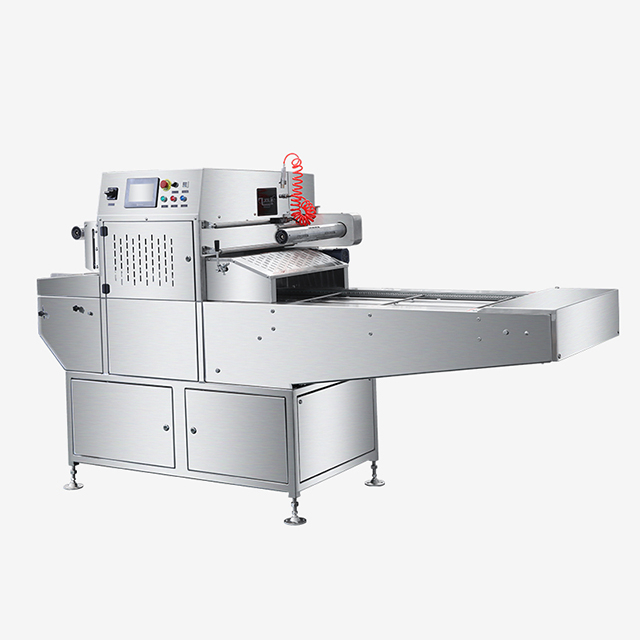
3. Tray-Based Modified Atmosphere Packaging: Upon exiting the tunnel, the trays are fed directly into the HVT-650A tray-sealing machine, which performs a continuous cycle of vacuuming, gas flushing (with a protective gas mixture), and sealing.
4. Inspection and Rejection: After packaging, the trays pass through an in-line metal detector. Non-compliant products are automatically removed by a rejection mechanism, while compliant products are rapidly moved out of the primary packaging area to prevent cross-contamination and temperature rise.
l Production Line Integration: Fully automated system with a single-lane infeed/outfeed; it connects directly to upstream conveyor lines, eliminating the need for intermediate storage hoppers.
l Construction Materials: Built using 304 stainless steel and 6061 aluminum alloy, offering a balance of corrosion resistance and structural strength, while facilitating easy daily washdown and cleaning. Multi-mode Operation: Supports three distinct processes—sealing only, vacuum sealing, and modified atmosphere packaging (MAP). With interchangeable molds, a single machine can accommodate various tray specifications, meeting the needs for product upgrades and multi-format production.
l Servo-Driven Tray Feeding/Gripping: Powered by servo motors, this system ensures precise positioning and consistent cycle times, meeting the high-efficiency requirements of dual-station continuous production.
l Operational Monitoring: Real-time display of program status and fault information, allowing operators to stay informed about the equipment's operational condition at all times.
l Safety Protection: Equipped with an emergency stop switch; pressing it immediately halts all active processes, ensuring the safety of both personnel and equipment.
Packaging speed per production line: 40 trays/minute. Each line requires 2 personnel in the primary packaging area (for film replacement and inspection of tray seals) and 2 personnel in the secondary packaging area (for tasks such as handling cartons, replacing tape and strapping, and managing tray stacks).
Vacuum packaging involves placing shrimp into a vacuum bag and removing the air, causing the film to conform tightly to the surface of the shrimp. This inhibits oxidation and reduces moisture loss, thereby preserving freshness. This method is primarily used for shrimp meat (peeled/deveined shrimp) and is well-suited for seafood suppliers with smaller production volumes. Users can select from tabletop, vertical, dual-chamber, or continuous-type models based on their specific product format and production capacity.
Tray packaging involves placing shrimp into a tray and sealing it with a top film. This category includes modified atmosphere packaging (MAP), vacuum skin packaging (VSP), and simple sealing. It is commonly used for shell-on fresh shrimp, cooked shrimp, and frozen shrimp. The finished packages have a structured, professional appearance, making them ideal for high-end retail channels. Available configurations include tabletop, vertical, rotary, continuous, and fully automated models, which can be selected based on required production capacity and the desired level of automation.
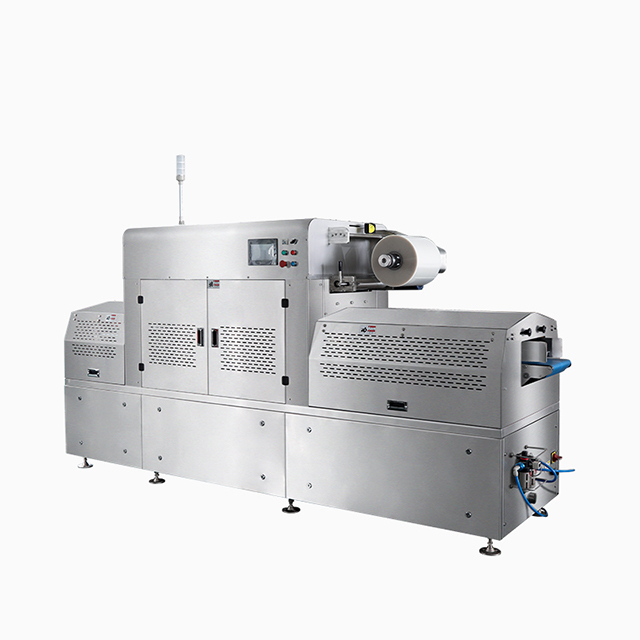
This machine utilizes an in-line thermoforming process: the bottom film is heated and shaped into trays, after which the top film is sealed over them. By eliminating the need for pre-made trays, this method enables high-speed packaging while reducing costs associated with packaging materials and storage, making it ideal for large-scale, continuous production. The forming molds can be swapped to accommodate products of various sizes and shapes. Furthermore, the system can be integrated with modified atmosphere packaging (MAP) or vacuum packaging technologies, making it well-suited for the large-scale packaging of fresh or frozen seafood, such as whole shrimp and shrimp meat.
Model | Vacuum Packaging Machine | Tray Packaging Machine | Thermoforming packaging machine |
Packaging Format | Pre-made vacuum bags | Tray + lidding film | Formed bottom tray (from bottom film) + top sealing film |
Key Processes | Vacuum sealing | MAP / VSP / Sealing only | MAP / VSP / Sealing only |
Typical Products | Shrimp meat | Fresh shell-on shrimp, cooked shrimp, frozen shrimp | Fresh shrimp, shrimp meat, frozen seafood |
Production Scale | Small-batch | Medium to large-batch | Large-batch continuous production |
Equipment Configuration | Tabletop, floor-standing, dual-chamber, continuous | Tabletop, floor-standing, rotary, continuous, fully automatic | Primarily continuous; interchangeable molds available |




 English
 简体中文
 ไทย
 Pусский