Views: 0 Author: Site Editor Publish Time: 2026-05-27 Origin: Site


Table of Content
What Is a Rollstock Thermoforming Packaging Machine?
What Is a Cut-Off Thermoforming Packaging Machine?
How Rollstock Thermoforming Packaging Machines Work
How Cut-Off Thermoforming Packaging Machines Work
Rollstock vs. Cut-Off Thermoforming Machines: Key Differences
When Rollstock Thermoforming Machines Make More Sense
When Cut-Off Control Matters More
Key Buying Factors When Comparing Rollstock and Cut-Off Systems
Not every thermoforming packaging machine handles film, package formation, and cutting in the same way. Some systems are mainly defined by their continuous roll-fed workflow, while others place more emphasis on how formed packs are separated into finished units.
That difference matters because rollstock and cut-off control can affect production flow, material use, pack consistency, changeover time, output, and line layout. If you choose the wrong setup, you may end up with unstable film feeding, poor edge quality, slower discharge, material waste, or finished packs that do not move smoothly into labeling, cartoning, or case packing.
This guide compares rollstock and cut-off thermoforming packaging machines so you can understand which format better fits your product, packaging style, output target, and factory workflow.
A rollstock thermoforming packaging machine uses film from rolls to form packages continuously during production. The bottom film is unwound, heated, formed into cavities, loaded with product, sealed with top film, and then cut into finished packs.
This format is usually chosen when you want continuous packaging flow, repeatable pack dimensions, and better integration between forming, sealing, and cutting. Instead of relying on pre-made trays or pouches, the machine forms the package from film during the packaging process.
Rollstock thermoforming can support different packaging needs depending on the machine configurationand film structure.
A cut-off thermoforming packaging machine focuses on how formed film or packaging material is separated into individual pack sections during the thermoforming process. The key idea is not only forming the package, but also separating packs through cross-cutting and longitudinal cutting.
Cut-off control is useful when finished packs need clean edges, accurate sizing, and precise separation. This can matter for retail packs, portion packs, medical products, food packs, and products that move directly into labeling, cartoning, or case packing.
In practical buying discussions, rollstock and cut-off are not always completely separate categories. Many rollstock thermoforming systems include cutting units, so you should compare the workflow focus rather than treating them as unrelated machines. Rollstock describes how the film is fed and formed. Cut-off control describes how accurately the finished packs are separated.
Rollstock machines start with continuous film rolls. The lower film is pulled into the forming section, heated, and shaped into cavities. Film width, forming depth, mold layout, and film structure all affect how many packs can be made per cycle.
If your product is shallow and uniform, the machine may form several cavities per cycle. If your product is taller, heavier, or irregular, the forming depth and mold layout need more careful planning. The film must stretch properly without becoming weak at the corners or losing pack stability.
After forming, products are placed into the cavities manually or automatically. Loading speed can become a bottleneck if your operators or automatic feeding systems cannot keep up with the film movement.
Rollstock systems work best when pack size, product placement, and spacing are repeatable. This is why they are often used for products with stable dimensions or predictable loading patterns. Irregular products can still be packed, but you need to plan the loading method carefully so the line does not slow down.
Once the product is loaded, the top film is applied. Depending on the machine configuration, the pack may be vacuumed, gas-flushed, sealed, and then cut into finished units.
Cutting is part of the rollstock process, but the main advantage is the continuous film-fed workflow. Poor cutting alignment can still affect pack appearance, separation, and downstream handling. If the pack edges are uneven or separation is poor, the problem can continue into inspection, labeling, cartoning, or case packing.
In a cut-off-focused thermoforming process, the material is shaped into package sections before being separated into individual packs or groups. This matters when the finished package needs cleaner separation, controlled sizing, or precise individual product segments.
The forming step still needs to match your product size, height, film structure, and pack design. However, the quality of finished separation becomes especially important because the cut-off section determines how cleanly the pack leaves the system.
Cross-cutting separates packs across the film direction, while longitudinal cutting separates them along the film direction. Both cutting actions affect final pack size, edge quality, material waste, and downstream packing.
Cutting accuracy becomes more important when your finished packs move into labeling, cartoning, case packing, or retail display. A small cutting error can create rough edges, uneven pack dimensions, poor stacking, or rejected packs.
Once packs are separated, they must move cleanly to discharge, inspection, or downstream handling. Poor separation can cause pack jams, uneven transfer, damaged edges, or slower line flow.
This is why cut-off control should not be treated as a small finishing step. It affects how the whole line performs after sealing.
Comparison Point | Rollstock Thermoforming | Cut-Off Control |
Main focus | Continuous film-fed package formation | Clean separation of finished packs |
Film handling | Uses film rolls to form packs during production | Focuses on how formed packs are cut and separated |
Production flow | Better for continuous packaging rhythm | Better when finished pack separation needs tighter control |
Pack consistency | Depends on synchronized forming, sealing, and cutting | Depends heavily on cutting accuracy and edge quality |
Material use | Can reduce reliance on pre-made trays or pouches | Poor cutting can increase trim, scrap, and rejected packs |
Changeover | May involve film rolls, molds, sealing settings, and cutting patterns | Requires attention to cutting length, knife alignment, and pack dimensions |
Rollstock machines are defined by continuous film feeding from rolls. Cut-off systems are defined more by how formed packaging is separated into individual sections.
Because many rollstock systems include cutting, you should ask how the machine handles both film feeding and pack separation. A strong rollstock process still needs accurate cutting to produce clean, usable packs.
Rollstock systems usually support a more continuous production rhythm. This can help when you need steady output and repeatable pack dimensions.
Cut-off-focused systems place more emphasis on finished pack separation and edge precision. The better choice depends on whether you care more about continuous throughput, individual pack separation, or both.
Rollstock machines can create consistent pack dimensions when film feeding, forming, sealing, and cutting are well synchronized. This matters if your packs need to move through downstream equipment without constant adjustment.
Cut-off performance becomes especially important where edge quality, individual pack dimensions, and downstream handling are sensitive. Poor cutting can weaken the value of an otherwise stable thermoforming line.
Rollstock machines can reduce dependence on pre-made trays or pouches because packs are formed from film rolls. This can support better material control when film width, mold layout, and pack spacing are planned properly.
Cut-off precision also affects material waste. Poor cutting, edge trim, or misalignment can increase scrap. Material efficiency depends on film width, mold layout, pack spacing, forming depth, and cutting accuracy.
Rollstock machines may require changes to film rolls, molds, forming tools, sealing settings, and cutting patterns. Cut-off-focused setups may require closer attention to cutting length, cross-cut alignment, longitudinal knives, and finished pack dimensions.
If you run several product formats, ask how long format changes take and how easily operators can adjust the cutting section.
Rollstock machines are often selected for higher continuity, but real output depends on forming time, loading speed, vacuum time, gas-flushing time, sealing time, cutting accuracy, and discharge flow.
Rollstock machines are usually a stronger fit when you need continuous packaging and repeatable pack output. They are useful when production volume has outgrown slower manual packing, chamber vacuum machines, or pre-made packaging formats.
If your line needs to run steadily for long periods, a roll-fed system can reduce unnecessary handling and support a smoother packaging rhythm.
Rollstock machines work well when your products have consistent dimensions, pack sizes, and loading patterns. Repeated product formats help the line run more smoothly and reduce unnecessary interruptions.
If your product range changes constantly, you may still use rollstock thermoforming, but you need to pay closer attention to mold changeover, film compatibility, and cutting pattern adjustment.
Rollstock thermoforming can support vacuum packaging or MAP workflows depending on the machine configuration. This makes it useful for products that need shelf-life support, oxygen reduction, or controlled atmosphere packaging.
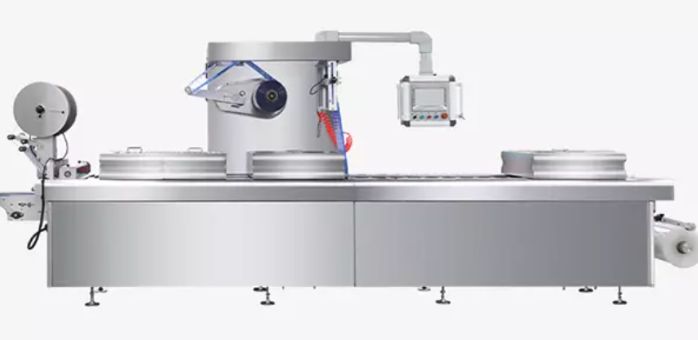
For example,HVR-320A can be used as a rollstock vacuum packaging machine if you are looking at continuous forming, vacuuming, sealing, and cutting.
Cut-off performance matters when the finished package needs clean edges, accurate dimensions, and easy separation. This is important for retail packs, portion packs, medical products, food packs, and items that move directly into labeling or cartoning.
If your finished packs must look clean on the shelf or fit into a fixed carton size, cutting accuracy becomes a key part of machine selection.
Accurate cutting helps finished packs move more reliably into conveyors, inspection, labeling, cartoning, or case packing. Poor cut-off alignment can create jams, uneven stacking, rejected packs, or slow manual correction.
If your line includes automation after sealing, you cannot ignore the cutting section. Downstream equipment often depends on consistent pack shape and spacing.
Some products require very consistent finished-pack dimensions. In these cases, cutting quality affects both appearance and downstream automation, not just pack separation.
You should pay close attention to cross-cutting, longitudinal cutting, blade wear, alignment, and scrap removal if your packs must meet tight size tolerances.
Start with your product. Size, shape, height, moisture level, fragility, freshness needs, and presentation goals all affect forming, loading, sealing, and cutting. Soft food, seafood, meat, ready meals, medical items, and industrial products may need different setups.
Next, decide your packaging method. Vacuum, MAP, skin packaging, rigid film, flexible film, and aluminum film packaging all affect machine configuration, film choice, forming depth, sealing method, and cutting requirements.
Film structure also matters. Flexible, rigid, semi-rigid, aluminum, barrier, peelable, and anti-fog films behave differently during forming, sealing, and cutting.
You should also check forming depth, mold layout, cutting accuracy, loading speed, changeover needs, and maintenance support. Cutting accuracy is especially important because it affects finished pack size, edge quality, downstream movement, and waste control. Ask whether the machine can maintain accurate cutting at your required output level.
Do not choose a thermoforming packaging machine by label alone. Rollstock thermoforming is mainly about continuous film-fed package formation, while cut-off control is about how accurately and cleanly finished packs are separated.
The right choice depends on your product type, film structure, forming depth, packaging method, output target, cutting accuracy, loading speed, changeover needs, and downstream handling. A rollstock machine may be the better option if you need continuous production, standardized packs, and integrated vacuum or MAP packaging. Strong cut-off control becomes more important when you need clean edges, precise finished dimensions, and smooth downstream packing.
If you need help matching a thermoforming packaging machine to your product, film, pack format, and production workflow, Hualian Machinery can help you compare options based on your packaging goals and line requirements.
Not exactly. A rollstock thermoforming machine is defined by continuous film feeding from rolls. Cut-off control refers to how formed packs are separated into finished units. Many rollstock machines include cutting systems, so the two ideas can overlap in real production.
You should consider rollstock thermoforming when you need continuous packaging, repeatable pack dimensions, efficient film use, and better integration between forming, sealing, vacuuming or gas flushing, and cutting.
Cut-off accuracy affects finished pack size, edge quality, pack separation, material waste, and downstream handling. Poor cutting can cause jams, rejected packs, uneven stacking, and problems during labeling, cartoning, or case packing.
Rollstock thermoforming can be used for meat, seafood, cheese, ready meals, medical items, hardware, industrial products, and other products that need repeatable pack sizes and continuous packaging flow.
You should check product size, film structure, forming depth, mold layout, packaging method, loading speed, cutting accuracy, changeover process, maintenance needs, and downstream handling requirements.

 English
 简体中文
简体中文 ไทย
ไทย Pусский