Views: 0 Author: Site Editor Publish Time: 2026-05-28 Origin: Site


Table of Content
The Core Difference: Forming the Pack vs. Sealing the Tray
How a Thermoforming Packaging Machine Builds the Pack
How a Tray Sealer Works With Pre-Made Trays
What Changes When You Choose Thermoforming Instead of Tray Sealer?
Which Products Usually Fit Thermoforming Better?
Which Products Usually Fit Tray Sealing Better?
How the Choice Affects the Packaging Line
Cost Should Be Compared Beyond the Machine Price
Some packaging lines start with film. Others start with a tray.
That is the simplest way to understand the difference between a thermoforming packaging machine and a tray sealer. A thermoforming packaging machine creates the package cavity from rollstock film during production. A tray sealer works with pre-made trays and focuses on sealing the product inside them.
Both machines can support food packaging, shelf-life protection, and sealed product presentation. But they do not solve the same packaging problem in the same way. If you choose the wrong format, you may deal with higher material costs, slow changeovers, poor product fit, unstable sealing, excess storage needs, or a line layout that does not match your production flow.
In this guide, we explain how to compare thermoforming packaging machines and tray sealers based on product type, packaging format, material use, changeover, cost, and production workflow.
The main difference is where the package structure comes from.
A thermoforming packaging machine starts with rolls of film. The machine heats and forms the lower film into cavities, the product is loaded into those cavities, and the top film is sealed over the product. The machine then cuts the finished packs.
A tray sealer starts with pre-made trays. The tray already defines the pack shape before it reaches the machine. The product is placed into the tray, and the machine seals film over the tray.
Comparison Point | Thermoforming Packaging Machine | Tray Sealer |
Starting material | Rollstock film | Pre-made trays plus sealing film |
Main function | Forms the pack and seals it | Seals film over an existing tray |
Pack shape | Created on the machine | Defined by the tray |
Typical strength | Continuous pack formation | Tray-based presentation and portion control |
Changeover focus | Film, molds, forming depth, cutting pattern | Tray size, tray mold, sealing film, tray material |
Best fit | Products suited to formed cavities and rollstock workflow | Products that benefit from rigid or semi-rigid trays |
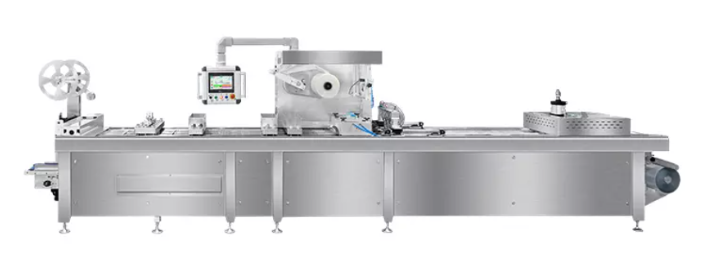
A thermoforming packaging machine uses rollstock film to create the pack during production. Instead of feeding pre-made trays into the line, the machine forms cavities from the bottom film, loads the product, seals the pack, and cuts it into finished units.
A typical rollstock thermoforming workflow looks like this:
Bottom film feeding: The lower film is pulled from a roll into the machine.
Heating and forming: The film is heated and formed into cavities using a mold.
Product loading: Products are placed into the formed cavities manually or automatically.
Vacuuming or gas flushing: Air may be removed or replaced with gas, depending on the packaging method.
Top film sealing: The upper film is sealed over the product.
Cutting: Finished packs are cut into individual units.
Discharge: Packs move to inspection, labeling, cartoning, or case packing.
This setup is useful when you want consistent formed cavities, continuous packaging flow, and less reliance on pre-made trays. It is often considered when product fit, film structure, pack depth, and line efficiency all matter.
Thermoforming packaging can be especially useful when you need the pack to follow the product more closely. Meat portions, seafood, cheese, sausages, sliced products, medical items, and some industrial parts may benefit from formed cavities because the package can be designed around the product shape, thickness, and protection needs.
However, thermoforming does require proper film selection, mold planning, forming depth control, cutting accuracy, and line setup. If the product changes often or if you already rely on specific tray formats, a tray sealer may be easier to manage.
A tray sealer does not form the tray. It works with trays that already exist.
The product is placed into a pre-made tray, then the tray sealer applies film over the top and seals it to the tray rim. Depending on the model and configuration, a tray sealer may support simple sealing, vacuum sealing, modified atmosphere packaging, or skin packaging.
A typical tray sealing workflow looks like this:
Tray feeding: Pre-made trays are placed manually or automatically into the machine.
Product loading: The product is placed into the tray.
Film application: Sealing film is applied over the tray.
Vacuum or MAP step: Air may be removed or replaced with gas where needed.
Sealing: The film is sealed to the tray rim.
Film cutting: Excess film is cut around the tray.
Discharge: Sealed trays move to labeling, inspection, or packing.
Tray sealing is practical when the tray itself is part of the packaging value. Ready meals, fresh foods, meat cuts, seafood, prepared foods, and portioned products often use trays because they provide structure, separation, presentation, and easier handling.
If you package ready meals, for example, the tray is not just a container. It may support portion control, product separation, retail display, reheating, stacking, and transport. In that case, sealing a pre-made tray may be more practical than forming a flexible or semi-rigid cavity from rollstock film.
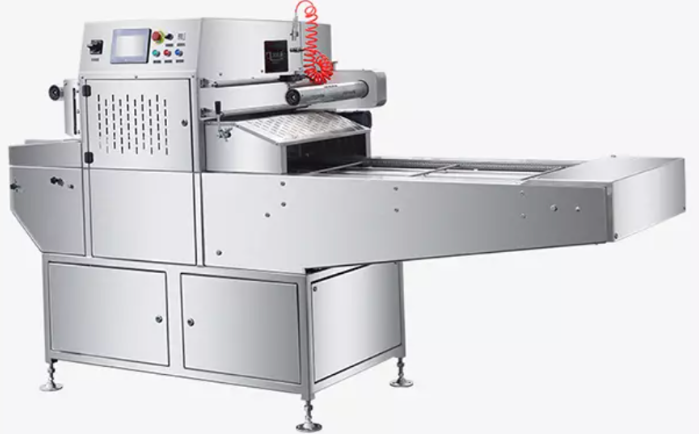
When your line is built around PP or PE trays and needs vacuuming, gas flushing, sealing, and film cutting, a tray-based MAP system such as theHVT-450A Automatic Food MAP Tray Sealer fits naturally into that workflow because the machine’s job is to seal and protect products that already sit inside defined tray formats.
Choosing between thermoforming and tray sealing changes how materials enter the line, how the pack is designed, how operators handle changeovers, and where waste can appear. The right choice depends on your product and workflow, not only the equipment price.
Thermoforming mainly requires rollstock film. Tray sealing requires stacks of pre-made trays plus sealing film.
This can make a major difference in your storage planning. Film rolls are usually more compact than stacks of trays, but thermoforming may require different film types, film widths, and roll handling systems. Tray sealing may require more warehouse space because trays take up physical volume even before production starts.
If you use tray sealing, you also need to manage tray inventory carefully. Running out of one tray size can stop production even if sealing film is available. If a supplier changes tray dimensions or delivery schedules, your line may be affected.
With thermoforming, you may have more control over cavity formation from film, but you still need stable film supply, proper film storage, and the right film structure for forming and sealing.
Thermoforming gives you more control over cavity design, forming depth, and pack layout. Since the pack is formed on the machine, you can design the cavity around product thickness, shape, portion size, and pack arrangement.
Tray sealing depends more on the tray sizes and shapes already available or sourced from suppliers. You may be able to order custom trays, but that adds another supplier and inventory factor.
Design Factor | Thermoforming Packaging Machine | Tray Sealer |
Cavity shape | Formed on the machine | Already defined by tray |
Depth control | Controlled by mold, film, and forming setup | Controlled by tray design |
Pack layout | Can be planned through mold layout | Limited by tray format |
Presentation | Can be compact or structured depending on film | Strong tray-based display |
Customization | Requires mold and film planning | Requires tray sourcing or custom tray production |
Thermoforming may be better if you want the package to fit the product closely and reduce unused space. Tray sealing may be better if the product benefits from a defined tray structure, compartments, or a retail-ready tray format.
Thermoforming changeover may involve film rolls, molds, forming depth, sealing settings, and cutting patterns. If you run different product sizes or pack formats, this must be planned carefully.
Tray sealing changeover usually involves tray size, sealing mold, tray material, sealing film, and sealing settings. If you switch between tray formats often, you need to know how quickly the machine can be adjusted and whether operators can manage the change without repeated sealing errors.
In both cases, changeover affects production time. The difference is where the complexity sits. Thermoforming changeover is often tied to film and cavity formation. Tray sealing changeover is often tied to tray fit, rim sealing, and tray-film compatibility.
Thermoforming waste can come from film trim, poor forming, wrong film selection, or cutting misalignment. If the film does not form cleanly or the cut pattern is not aligned, you may create more scrap than expected.
Tray sealing waste can come from damaged trays, mismatched tray-film combinations, failed seals, or tray inventory that no longer fits product needs. If trays crack, warp, arrive out of tolerance, or do not match the sealing tool, your rejection rate can increase.
Neither system is automatically lower waste. Material efficiency depends on:
Film width
Tray design
Mold layout
Pack spacing
Forming depth
Sealing quality
Cutting accuracy
Product fit
Changeover control
A cheaper material strategy can become expensive if it leads to slow production, rejected packs, or poor shelf-life performance.
Thermoforming is usually a better fit when the product and pack need to be shaped together. It is useful when you want formed rollstock packs, tighter packaging, integrated vacuum or MAP workflows, and consistent production flow.
Products that often fit thermoforming include:
Meat portions
Seafood
Cheese
Sausages
Sliced products
Medical items
Hardware
Industrial parts
Products needing close pack fit
Products suited to flexible or semi-rigid film packs
The key is the product-pack relationship. If the product benefits from a formed cavity, close film fit, controlled pack depth, or continuous film-fed operation, thermoforming may make more sense.
For example, sliced cheese or meat portions may not need a rigid tray if the product can sit neatly inside a formed cavity. Some seafood products may need vacuum or gas-flushing support but not necessarily a pre-made tray. Some medical or industrial items may need consistent cavities and sealed protection more than tray presentation.
In food packaging, a rollstock system such as the HVR-420A Automatic Vacuum Thermoforming Packaging Machine fits this type of decision when the product needs thermoformed cavities along with vacuum or gas-flushing workflows.
Thermoforming may also make sense if your production volume is high enough to benefit from continuous film-fed packaging. If you are packaging the same product or similar product sizes repeatedly, the machine can help create stable output and reduce dependence on pre-made tray supply.
Tray sealing is usually better when the tray itself is part of the value. If the product needs structure, portion support, retail display, or easier handling, pre-made trays may be more practical.
Products that often fit tray sealing include:
Ready meals
Fresh produce
Prepared foods
Meat cuts
Seafood portions
Takeaway-style meals
Products with sauces or mixed components
Products that need compartment trays
Retail food packs needing tray presentation
Tray sealing works well when your product already fits a standard tray format and the main job is to seal, protect, and present it cleanly. For example, a ready meal may need a rigid tray because it holds different food components, supports reheating, and gives the product a clear retail format. Fresh produce may need a tray to prevent crushing and improve shelf display. Prepared foods may need a tray to support sauces, toppings, or portion control.
Tray sealing can also simplify packaging when tray sizes are already standardized across your product range. If your product line uses two or three tray formats repeatedly, a tray sealer may offer a practical balance between flexibility and finished-pack presentation.
The choice between thermoforming and tray sealing affects more than the machine body. It changes loading, sealing, cutting, downstream handling, labor planning, and automation.
Thermoforming requires products to be placed into formed cavities. Tray sealing requires products to be placed into pre-made trays.
That sounds similar, but the loading experience can be different. In thermoforming, the cavity comes from the lower film, so the product must fit the formed pocket properly before sealing. In tray sealing, the tray already provides structure, which can make loading easier for products that need support, spacing, or portion separation.
Loading speed, product shape, and operator movement can affect both systems. If your product is irregular, fragile, or wet, you need to consider how easily it can be placed into the pack. If you plan to automate loading, the product format must be consistent enough for the feeding system to keep up.
Thermoforming usually combines sealing and cutting after pack formation. The lower film is formed, the top film is applied, and the final pack is sealed and separated.
Tray sealing focuses on sealing film to tray rims and cutting film around the tray. The tray rim becomes the critical sealing surface. If the tray rim is wet, contaminated, warped, or mismatched with the film, sealing problems can appear.
Sealing quality is critical in both systems, but the failure points are different.
Packaging Issue | Thermoforming Risk | Tray Sealing Risk |
Weak seal | Film mismatch, poor sealing control, product in seal area | Wet tray rim, damaged tray, wrong sealing film |
Poor appearance | Poor forming, rough cutting, weak cavity design | Wrinkled lid film, tray deformation, poor rim seal |
Leakage | Bad seal, puncture, poor film structure | Failed tray-film seal, cracked tray |
Cutting problems | Misaligned cutting, film trim waste | Poor film cut around tray edge |
Shelf-life failure | Weak barrier film or seal failure | Tray-film mismatch or seal failure |
You need to evaluate sealing based on the actual pack structure, not only the machine type.
Thermoformed packs and sealed trays may behave differently during conveying, labeling, cartoning, stacking, and transport.
Tray packs often offer more rigid handling because the tray gives the product structure. This can help with stacking, display, and transport. However, trays may take up more space and can add material cost.
Flexible thermoformed packs may save space depending on the product and film structure. They can be compact, efficient, and suitable for products that do not need rigid tray support. But if the pack is too flexible for your downstream equipment, it may need additional support during conveying or cartoning.
Before choosing the machine, think about what happens after sealing:
Will the packs be labeled automatically?
Will they move through checkweighing or inspection?
Will they be stacked by hand or machine?
Will they enter cartons or cases?
Will they be transported long distances?
Will retail display require a specific pack shape?
Machine price is only one part of the cost decision. To compare thermoforming and tray sealing properly, you need to look at total packaging cost.
Thermoforming cost factors may include:
Bottom film and top film
Film structure and barrier level
Mold cost
Forming depth
Film trim waste
Cutting accuracy
Machine complexity
Maintenance needs
Operator training
Line integration
Tray sealing cost factors may include:
Pre-made tray supply
Tray storage
Sealing film
Tray denesting
Sealing mold sets
Tray material
Rejected trays
Tray-film compatibility
Inventory management
Supplier reliability
The cheaper machine can become the more expensive system if the material strategy does not fit your product or production volume. For example, tray sealing may look simpler, but tray storage and tray supply can add cost. Thermoforming may reduce reliance on pre-made trays, but molds, film trim, and machine complexity must be considered.
A good cost comparison should answer these questions:
Cost Question | Why It Matters |
How many pack formats do you run? | More formats may increase mold or tray costs |
How often do you change products? | Frequent changeovers affect downtime |
How much storage space do you have? | Tray inventory may require more space |
What film or tray material does the product need? | Barrier, strength, and sealability affect cost |
What is your rejection rate? | Waste can outweigh equipment savings |
How much automation do you need? | Loading, denesting, sealing, and discharge affect total cost |
What will production volume look like in 12–24 months? | A cheaper short-term setup may limit future growth |
Do not compare only the purchase price. Compare the cost of running the full packaging format over time.
Neither machine is automatically better. A thermoforming packaging machine is stronger when rollstock film, cavity forming, continuous production, and close product fit make sense for your product. A tray sealer is stronger when pre-made trays, tray presentation, portion structure, and tray-based sealing fit the product better.
The right choice depends on your product, pack format, material strategy, output target, changeover needs, storage space, sealing requirements, and downstream handling. If you are packaging products that benefit from formed cavities and rollstock film, thermoforming may be the better route. If your product needs a defined tray format for structure, display, or portion control, tray sealing may be more practical.
If you need help comparing thermoforming packaging machines and tray sealers based on your product type, packaging format, and production workflow, Hualian Machinery can help you review the options and configure a line that fits your packaging goals.
Not always. A thermoforming packaging machine is better when you want to form the pack from rollstock film during production. A tray sealer is better when your product fits pre-made trays and the main goal is to seal, protect, and present the product cleanly.
Yes. Both formats can support modified atmosphere packaging depending on the machine configuration. In thermoforming, MAP is built into the rollstock forming and sealing workflow. In tray sealing, MAP is applied after the product is placed inside the pre-made tray.
Tray sealing is often better for ready meals because the tray provides structure, portion support, retail presentation, and sometimes reheating convenience. Thermoforming may still work for certain prepared products, but tray sealing is usually more practical when the tray is part of the product format.
It depends on the product, film, tray design, mold layout, and waste rate. Thermoforming can reduce dependence on pre-made trays, but film trim and forming waste must be considered. Tray sealing uses pre-made trays plus sealing film, but it may reduce waste if the tray format is stable and well matched to the product.
Compare product fit, packaging format, film or tray material, shelf-life needs, sealing quality, changeover time, material storage, output target, labor needs, downstream handling, and total packaging cost.

 English
 简体中文
简体中文 ไทย
ไทย Pусский